Scan to contact us

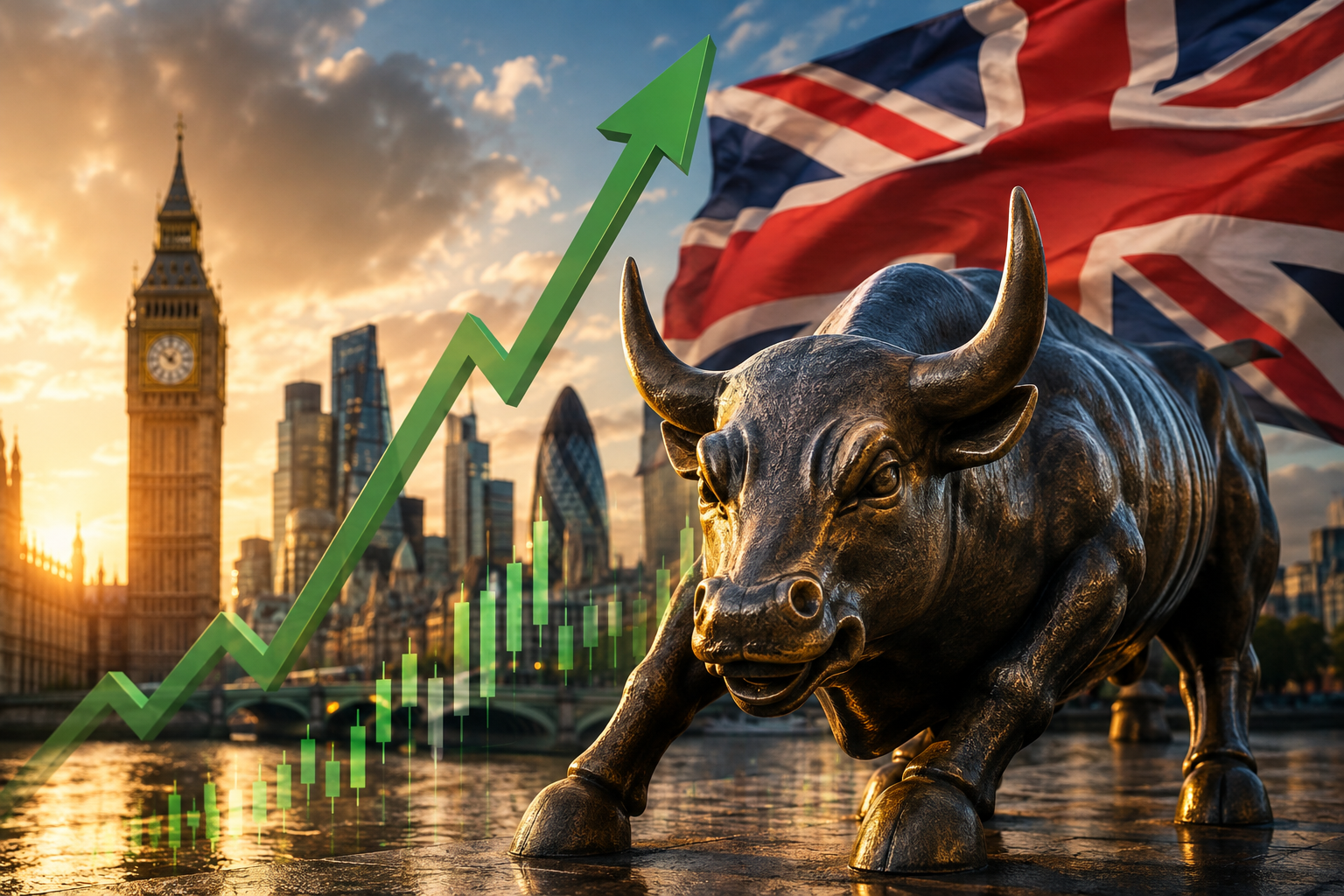
There's a line doing the rounds among market analysts right now that sums up Britain's unexpected stock market renaissance rather neatly: the FTSE is the anti-tech index. And in 2026, that's turned out to be exactly what global investors wanted.
UK shares have risen by around 19% over the past year, up nearly 4% in July alone. In January, the FTSE 100 crossed 10,000 points for the first time in its history — and did so in just 171 days after hitting 9,000, the fastest 1,000-point climb the index has ever seen. Over the same period, the UK has outpaced the S&P 500, which gained around 17%.
For a market that spent years being written off — dismissed for its lack of tech giants, battered by Brexit sentiment, and quietly abandoned by retail investors — the reversal has been striking.
The Tech Unwind That Changed Everything
To understand what's driving Britain's rebound, you have to look west. In the US, investors have been reassessing the AI trade. The seven mega-cap companies that account for roughly a third of the S&P 500's entire market value — the Nvidias, the Microsofts, the Alphabets — have seen their valuations questioned as markets start to ask whether the artificial intelligence boom will ever translate into earnings that justify the hype.
South Korea's chipmakers have faced similar pressure. SK Hynix and Samsung, which effectively define their respective segments, have come off the boil as sentiment around semiconductors cools.
And that global rotation — out of growth, out of tech, into something more tangible — has found a natural landing place in the UK.
Britain's market is heavy in banks, healthcare, energy, consumer staples, and industrials. Oil services companies are performing strongly as crude prices remain elevated. Mining stocks have surged on the back of record gold and silver prices. Defence names like BAE Systems, Rolls-Royce, and Babcock have benefited from rising NATO spending commitments. These are not glamorous sectors. But they are profitable ones — and right now, that matters more than the narrative.
Not a Political Story
It's worth being clear about what this rally is not. It isn't a post-Brexit vindication. It isn't a bounce driven by the change of prime minister, the so-called "burn and bounce" that some commentators speculated about. Global capital markets are not particularly interested in domestic political storylines. What they are interested in is risk-adjusted return — and right now, Britain's composition offers something that's suddenly in short supply elsewhere: predictability.
One analyst has taken to calling the FTSE the "anti-tech index." It doesn't have anything as headline-grabbing as Nvidia or SpaceX. But it also doesn't have the concentration risk, the sky-high multiples, or the existential question of whether a single technology theme can sustain a trillion-pound valuation. At 13.5 times 2026 earnings forecasts, UK equities look reasonably priced by historical standards — and major institutions are taking notice. JPMorgan has projected further gains to near 11,000.
Boring, it turns out, can be beautiful.
What This Means Beyond the Markets
At Why Media, we work closely with clients in financial services, property, and professional services — businesses whose fortunes are closely tied to the confidence of institutional and high-net-worth investors. The FTSE's performance matters to them directly, but the shift in narrative matters even more.
Carl Piper, Agency Partner at Why Media, said:
"The story here isn't just about stock prices — it's about perception catching up with reality, and that's a fascinating thing to watch from an agency perspective. For years, the UK market was undervalued partly because the story being told about Britain didn't match the fundamentals underneath it. Now that the data is undeniable, the conversation is changing. That's a lesson I think applies directly to how businesses present themselves — the strongest brands don't wait for the market to discover them. They make the case proactively."
"For the financial and professional services clients we work with, this is a genuine moment of opportunity. Investor confidence is shifting back toward the UK, and businesses that have invested in their brand, their credibility, and their communications over the past few difficult years are the ones positioned to capture that renewed interest. The FTSE crossing 10,000 is a milestone — but the real opportunity is in what comes next."
The Patience Play
Markets often reward patience over prediction. The UK's listed companies didn't change dramatically over the past twelve months — what changed was the global context around them. The same diversified, dividend-paying, slightly unfashionable businesses that were overlooked during the AI gold rush are now exactly what cautious capital is seeking out.
The FTSE's moment illustrates something worth remembering for any business navigating a tough cycle: fundamentals don't disappear during a period of poor sentiment. They wait. And when conditions shift, the organisations that stayed the course — that kept investing in their product, their people, and their profile — tend to be the ones that benefit most from the turn.
Forecasts from AJ Bell put the FTSE at 10,750 by year-end. JPMorgan sees 11,000 as achievable. Neither outcome was imaginable to many investors just eighteen months ago.
Sometimes the most powerful market move is the one nobody saw coming — not because the signals weren't there, but because everyone was looking somewhere else.
Sources: Investment data via Invezz / Investing.com; FTSE 100 performance data via AJ Bell, JPMorgan, Charles Stanley. Why Media is a Mayfair-based creative and marketing agency specialising in finance, property, and professional services. whymedia.com
A FORWARD-THINKING AGENCY WITH A WORLD OF IDEAS *
A FORWARD-THINKING AGENCY WITH A WORLD OF IDEAS *