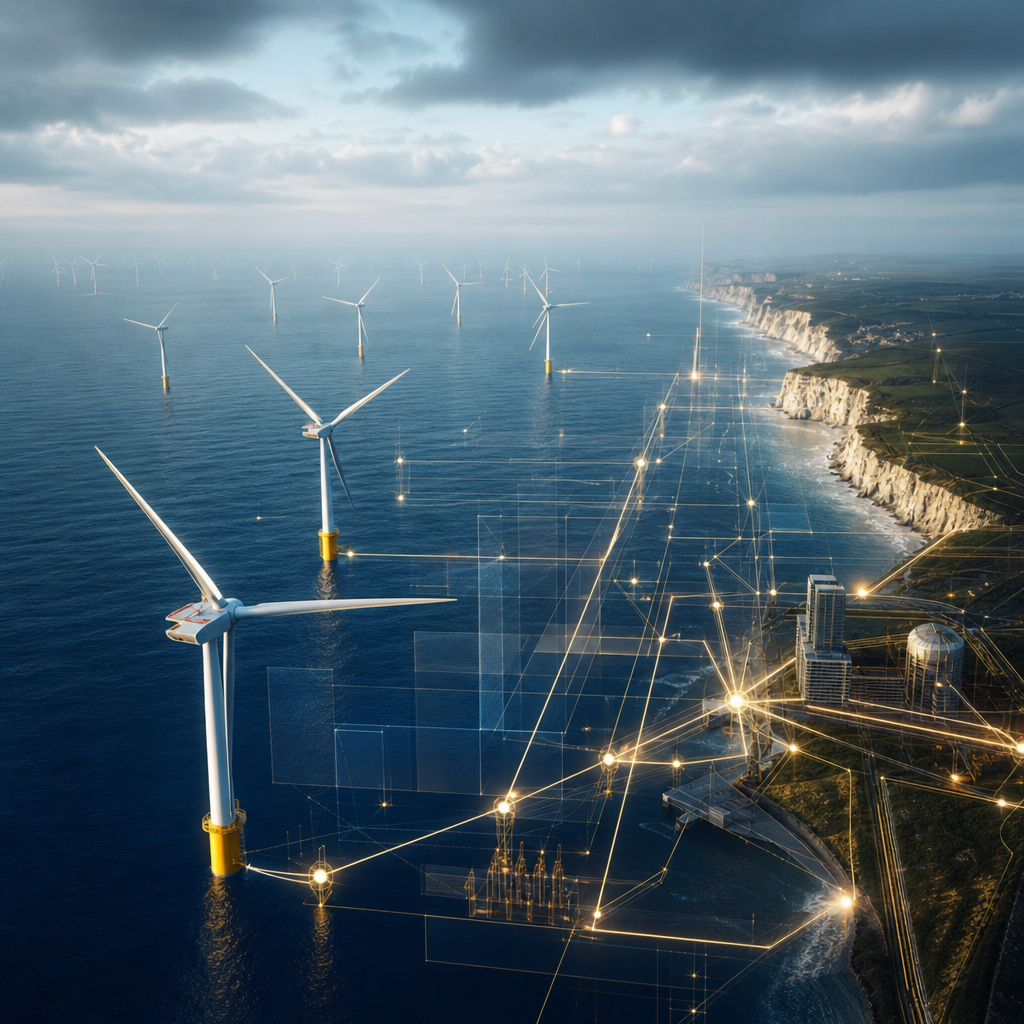
RWE and KKR have reached financial close on two major offshore wind projects in the British North Sea, securing around £12 billion of investment and what the companies describe as the largest project financing in UK offshore wind to date.
The 2.8-gigawatt Vanguard West and Vanguard East developments will be delivered through a 50:50 joint venture between the German energy group and the US investment firm. Both projects are expected to be fully commissioned in 2030.
Record financing secured
Financial close brings together £11.1 billion in cash facilities and a further £1.7 billion in ancillary facilities arranged through a consortium of 35 international banks.
The financing is structured on a non-recourse project-finance basis, allowing the projects to raise capital against their expected future revenues rather than relying solely on the broader balance sheets of RWE and KKR. The scale of the funding underlines the growing role of institutional investors and international lenders in financing Britain’s energy infrastructure.
KKR has acquired a 50 per cent equity stake in each project, formally establishing the joint venture with RWE. The partnership combines RWE’s experience in developing and operating renewable-energy assets with KKR’s ability to deploy large pools of long-term infrastructure capital.
Strategic importance for Britain
The projects will add substantial generating capacity in the North Sea and support the UK’s effort to expand offshore wind as part of its longer-term energy strategy. Their associated transmission infrastructure is included in the estimated £12 billion investment.
Offshore wind has become central to Britain’s plans to increase domestic electricity generation and reduce exposure to volatile international fossil-fuel markets. Large developments such as Vanguard West and Vanguard East are also expected to create demand across construction, engineering, ports and specialist marine services.
Execution remains the test
The financial close removes one of the largest barriers facing capital-intensive energy projects, but construction and grid delivery will determine whether the developments meet the 2030 commissioning target.
Offshore wind developers globally have faced pressure from higher financing costs, supply-chain constraints and rising construction expenses. Securing backing from a large banking consortium gives the projects a stronger foundation, while also highlighting the substantial capital required to build new generation capacity in the UK.
For Britain’s energy market, the announcement is both an investment milestone and a test of whether major offshore projects can be delivered at scale while maintaining investor returns and supporting the transition to a lower-carbon power system.
A FORWARD-THINKING AGENCY WITH A WORLD OF IDEAS *
A FORWARD-THINKING AGENCY WITH A WORLD OF IDEAS *