Scan to contact us

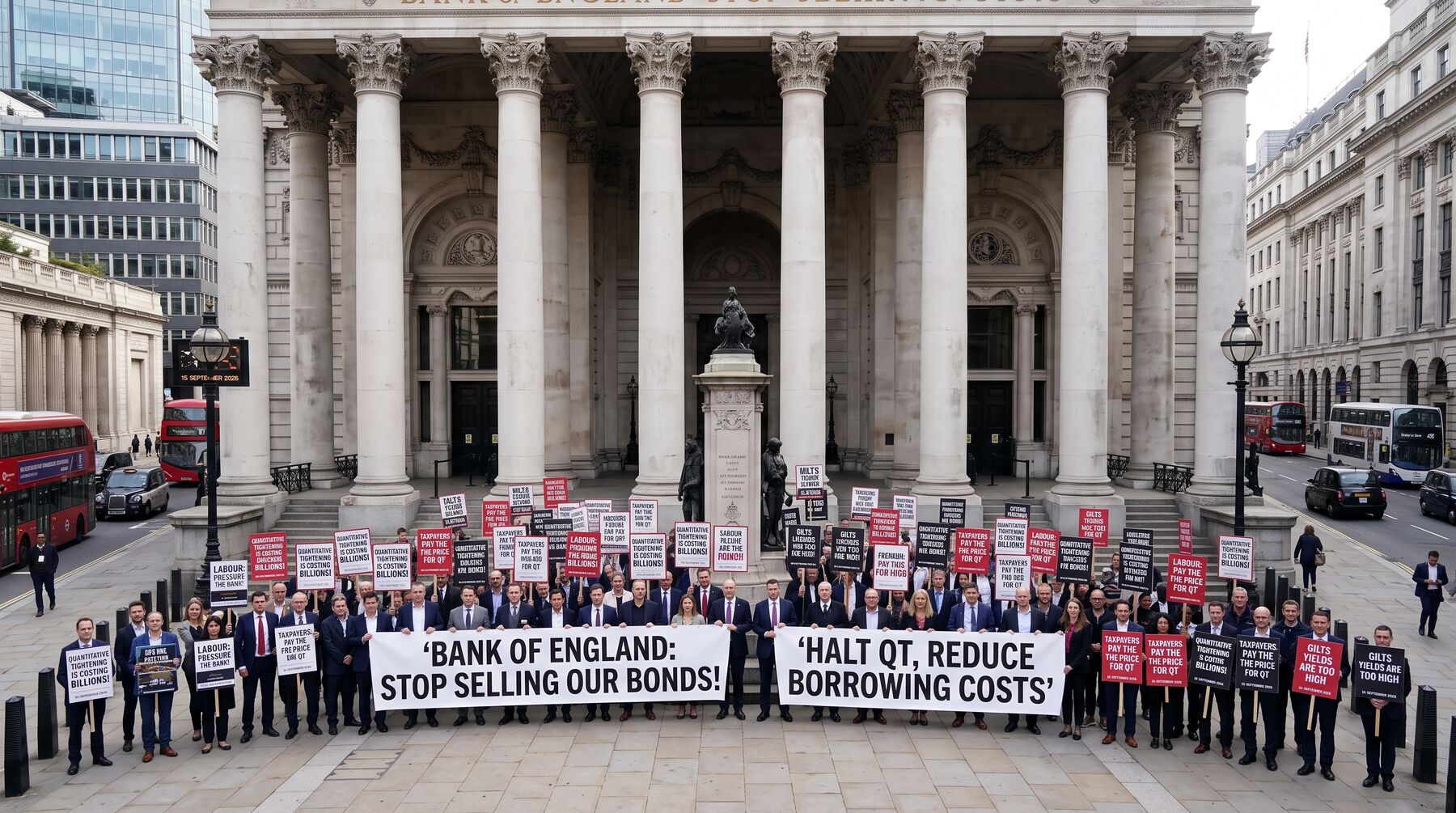
The most significant UK business and finance story on 15 September 2026 is mounting pressure on the Bank of England to slow or halt its programme of selling government bonds, amid concerns that quantitative tightening is driving up borrowing costs for the UK state and taxpayers.
Economists and commentators are urging ministers in the new Labour government, including Shadow-turned-Chancellor John Healey, to press the Bank to change course on its bond sales, arguing that the current strategy is costing the exchequer billions of pounds and complicating efforts to stabilise the public finances. This debate over quantitative tightening comes as gilt yields remain elevated and the government faces difficult trade-offs between fiscal consolidation, investment pledges and support for public services.
Bank of England’s bond-selling under scrutiny
According to UK business coverage, the central issue is the Bank of England’s ongoing unwinding of its quantitative easing (QE) programme by actively selling the large stock of gilts it accumulated during years of ultra-loose monetary policy. Under this policy, often referred to as quantitative tightening (QT), the Bank is not only allowing bonds to mature but also selling them back into the market, increasing the net supply of government debt that investors must absorb.
Economists cited in today’s reporting argue that this active bond-selling is pushing up longer-term interest rates and gilt yields relative to what they would be if the Bank adopted a slower, more passive approach. Higher gilt yields, in turn, translate directly into higher borrowing costs for the Treasury, raising the interest bill on the national debt and constraining fiscal space for other priorities.
Billions at stake for the exchequer
The criticism focuses on the fiscal impact of QT at a time when the UK’s public debt remains elevated and markets are highly sensitive to signals about fiscal and monetary policy coordination. Commentators estimate that the current pace and structure of bond sales is costing the exchequer several billions of pounds through higher interest payments and losses crystallised when selling bonds purchased at much lower yields during the QE era.
Because the Bank bought gilts when yields were very low, their resale at today’s higher yields can lock in capital losses that ultimately fall on the taxpayer via the indemnity arrangements between the Bank and the Treasury. Analysts argue that a slower run-off, or a shift to relying mainly on natural maturities rather than active sales, could reduce those losses and ease upward pressure on borrowing costs.
Political pressure on John Healey and the new government
Today’s coverage highlights calls for John Healey, a senior Labour figure now responsible for the public finances, to engage directly with the Bank on the design and pace of QT. Economists urge him to press the case that, while central bank independence over interest-rate decisions must be respected, the fiscal consequences of balance-sheet policy justify a reassessment of bond-selling.
The debate underscores the delicate balance the new government must strike: maintaining respect for the Bank’s operational independence while addressing the budgetary impact of its decisions at a time of tight fiscal constraints. A more coordination-focused approach, critics say, could help lower the cost of servicing debt without undermining the Bank’s inflation-fighting credibility.
Broader market and economic implications
The scrutiny of QT comes against a backdrop of mixed but closely watched labour market data and gilt auctions scheduled for today, which provide a live test of investor appetite for UK debt. Trading calendars show key releases, including the unemployment rate and average earnings, as well as gilt auctions for 2029 and 2040 maturities, underlining how sensitive markets currently are to both macroeconomic indicators and debt-management strategy.
Analysts note that persistently higher borrowing costs can crowd out other government spending, complicate plans for investment in infrastructure and public services, and potentially weigh on business confidence and private investment. For corporate borrowers, higher gilt yields often feed into higher corporate bond yields and loan rates, tightening financial conditions more broadly.
Debate over quantitative tightening strategy
The argument over QT is not whether the Bank should reduce its balance sheet at all, but how fast and through which mechanisms. A number of economists propose that the Bank could:
- Slow the pace of active bond sales and rely more heavily on letting existing holdings mature.
- Adjust the composition of sales to minimise market disruption at longer maturities.
- Increase transparency around the fiscal and market impact of QT decisions.
Supporters of the current approach, though less prominent in today’s coverage, would argue that a credible, predictable QT path helps anchor inflation expectations and normalise the monetary stance after years of extraordinary stimulus. The emerging debate, therefore, centres on whether the current balance between monetary objectives and fiscal costs remains appropriate given the UK’s debt profile and growth outlook.
What it means for households and businesses
For households, the controversy over bond-selling may seem remote, but its effects are concrete: higher gilt yields can translate into higher fixed-rate mortgage costs and more expensive consumer borrowing over time. Industry data released today point to weakening buyer demand and rising swap rates putting renewed pressure on mortgage affordability, underscoring how financial-market dynamics feed through into the housing market.
For businesses, especially those reliant on bank lending or capital markets, tighter financial conditions can delay investment decisions, slow hiring plans and raise the hurdle rate for new projects. If the government’s interest bill remains elevated, it may also limit the scope for tax incentives or targeted support schemes aimed at boosting corporate growth.
A pivotal moment for UK economic strategy
Today’s calls to rethink QT mark a pivotal moment in the UK’s post-pandemic, post-inflation economic strategy, as policymakers seek to move from crisis-era stimulus to a more sustainable equilibrium. How the Bank and the government respond will be closely watched in the City and beyond, given the potential implications for bond markets, fiscal sustainability and the broader trajectory of the UK economy.
Investors, businesses and households will be looking for clearer signals in coming weeks about whether QT will remain on its current track or be recalibrated to reduce pressure on borrowing costs and support a more balanced recovery.
A FORWARD-THINKING AGENCY WITH A WORLD OF IDEAS *
A FORWARD-THINKING AGENCY WITH A WORLD OF IDEAS *