Scan to contact us

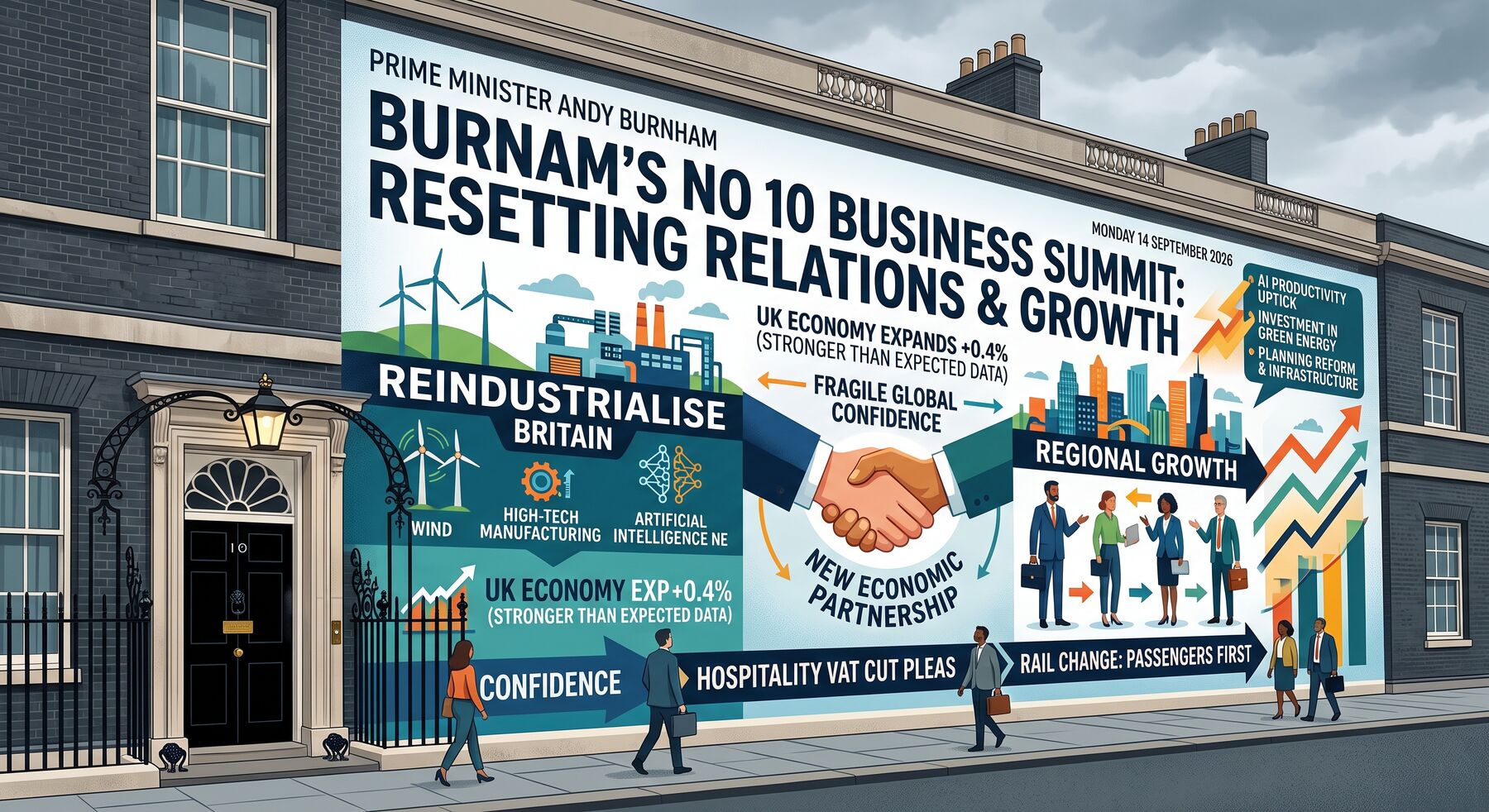
The most significant UK business and finance story today is Prime Minister Andy Burnham’s push to reset relations with corporate Britain, as he convenes business leaders, entrepreneurs and local mayors at No 10 to discuss a new growth agenda and his pledge to “reindustrialise Britain”.
This meeting, and the commitments around it, mark the first major attempt by the new government to define its economic partnership with the private sector, against a backdrop of fragile growth and ongoing pressure on consumers and firms.
Burnham’s No 10 summit: signalling a new era with business
Andy Burnham is hosting entrepreneurs and local mayors at No 10 on Monday 14 September, in a high-profile summit designed to put business at the centre of the UK’s growth strategy. The event follows briefings that he will call for a “culture shift” in how government and companies work together, positioning the meeting as the start of a long-term partnership rather than a one-off photo opportunity.
According to reports ahead of the summit, Burnham plans to set out a pro-investment agenda focused on productivity, innovation and regional growth, and to reassure corporate leaders that the government sees them as central to delivering higher living standards and better-paid jobs. The discussion is expected to cover regulation, planning, skills, infrastructure and the role of public-private partnerships in accelerating projects, particularly outside London.
Pledge to “reindustrialise Britain” and drive regional growth
Burnham has framed his economic strategy around a pledge to “reindustrialise Britain”, using a new partnership with business to rebuild manufacturing strength, expand clean energy and support advanced services such as AI and digital industries. This language marks a shift away from an era dominated by austerity and financial services, towards a more active industrial policy that seeks to channel private capital into long-term projects across the UK’s regions.
Local mayors have been invited to No 10 to reinforce the idea that growth should be geographically broad-based, not concentrated in the South East. The government is expected to emphasise its support for devolved powers and city-region investment plans, arguing that close collaboration between central government, town halls and businesses is essential to lift productivity and narrow regional inequalities.
Business backdrop: hospitality pressures and calls for clarity
The summit comes as parts of the UK economy, notably the hospitality sector, step up pressure on the government to follow through on campaign pledges. More than 800 hospitality businesses have urged Burnham to spell out plans for a promised VAT cut, warning that delays could trigger further closures and job losses in an industry still struggling with higher costs and uneven demand.
These concerns highlight the tension between the government’s long-term growth rhetoric and the immediate cash-flow pressures facing many firms, particularly small and mid-sized enterprises. For business groups, today’s meeting is not only about the broad direction of travel but also about whether the Prime Minister will offer near-term relief to sectors most at risk, and how quickly policy will move from consultation to implementation.
Economic context: stronger data but fragile confidence
The push to reset relations with business comes against a mixed economic backdrop. Recent official figures showed the UK economy expanded by around 0.4%, stronger than many analysts had expected and the fastest annual pace in about 18 months. The data suggested that investment linked to artificial intelligence and digital technologies is beginning to make a measurable contribution to growth.
Nevertheless, forecasters and policymakers continue to warn that overall momentum remains fragile, with global tensions and still-elevated borrowing costs weighing on confidence. Burnham’s team sees business investment as critical to turning short-term resilience into sustained expansion, and today’s summit is being cast as a key step in making the UK a more attractive destination for capital, skills and innovation.
Rail, regulation and the “passengers before shareholders” message
Alongside the No 10 meeting, the government is advancing changes in sectors such as rail that reinforce its broader narrative of putting consumers and workers ahead of corporate interests. New rules will give rail passengers an automatic right to switch operators for free when trains are cancelled, an attempt to end confusion and ensure that “passengers come first, not shareholders” when services are disrupted.
While primarily a transport story, this policy feeds into a wider regulatory agenda that is likely to be discussed with business leaders: how to balance investor returns with service standards and fairness, particularly in privatised or regulated industries. Companies will be watching closely to see whether the Prime Minister’s emphasis on partnership is matched by a predictable and stable regulatory environment, or whether more interventionist moves lie ahead.
What business will listen for at No 10
For corporate executives and investors, the immediate significance of today’s summit lies less in any single announcement and more in the signals Burnham sends on several core issues.
- Stability and predictability: Whether the government commits to clear fiscal rules and avoids frequent, surprise changes to tax and regulation, which have been a major complaint in recent years.
- Tax and investment incentives: Clarity on business taxation, VAT, and possible incentives for green investment, R&D and AI adoption.
- Planning and infrastructure: Commitments to accelerate planning decisions and unblock infrastructure projects that are key to growth in energy, transport and housing.
- Skills and labour markets: Plans to address skills shortages, improve training and support labour mobility, especially as technology reshapes industries.
- Regional investment: Concrete mechanisms for funnelling capital into cities and regions beyond London, in line with the “reindustrialise Britain” pledge.
Business groups will judge the success of the summit on whether it produces a credible roadmap on these fronts, backed by timelines and accountability, rather than broad aspirations alone.
Implications for markets and corporate strategy
Financial markets are unlikely to react dramatically to the optics of a single meeting, but investors will parse speeches and briefings for hints about future policy on corporate tax, regulation and public spending. A convincing pro-growth, pro-investment signal could support sentiment towards UK equities and sterling, particularly if it aligns with recent better-than-expected growth data and the emerging AI-driven uptick in productivity.
For companies operating in the UK, today’s summit is another reminder that political risk and opportunity are intertwined. Those in sectors favoured by industrial policy – such as clean energy, advanced manufacturing and digital services – may find themselves at the centre of the “reindustrialise Britain” agenda, while more consumer-facing industries like hospitality wait to see whether immediate tax relief accompanies the rhetoric.
In the coming weeks, the government’s follow-through on any commitments made today will determine whether this No 10 gathering is remembered as a symbolic reset or the start of a sustained, collaborative effort to reshape the UK’s economic model.
A FORWARD-THINKING AGENCY WITH A WORLD OF IDEAS *
A FORWARD-THINKING AGENCY WITH A WORLD OF IDEAS *