Scan to contact us

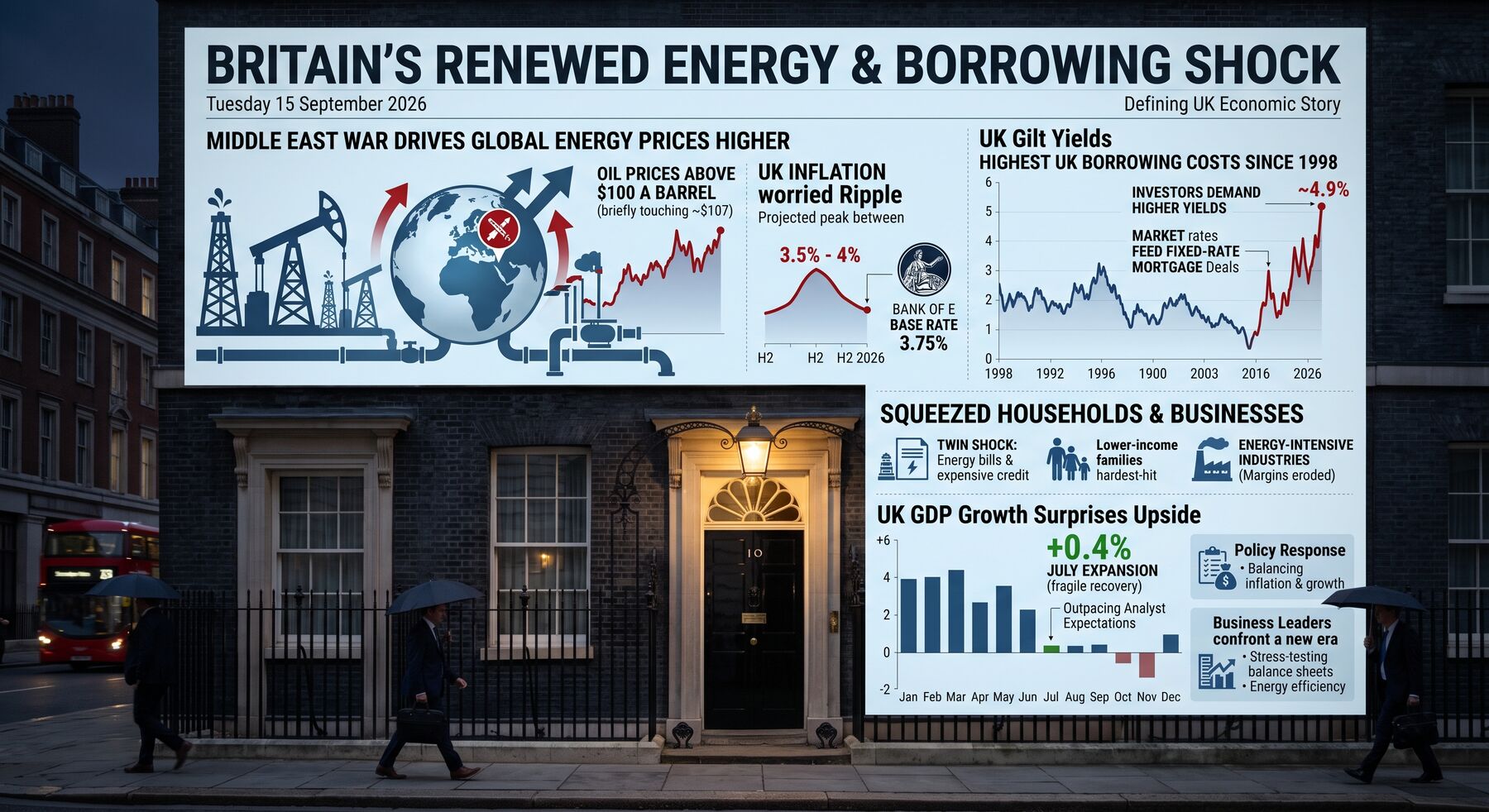
Britain’s struggle to shield households and businesses from a renewed global energy shock has emerged as the defining economic story for the UK, with soaring borrowing costs and inflation worries rippling through markets and boardrooms.
As war in the Middle East drives gas and oil prices higher, investors now expect UK borrowing costs to reach their highest levels since the late 1990s, intensifying pressure on mortgage holders, energy-intensive industries and already‑squeezed consumers.
Energy shock reshapes the UK economic outlook
The latest bout of volatility has its roots in the conflict that erupted in the Middle East in late February, triggering a sharp rise in global energy prices. Britain, one of the G7’s most gas‑dependent economies, is particularly exposed because natural gas still provides a larger share of household energy than in most other advanced economies.
Inflation, which had been drifting closer to the Bank of England’s 2% target earlier this year, is now projected to peak between 3.5% and 4% in the second half of 2026. The International Monetary Fund expects the UK to be among the hardest‑hit major economies, underlining how vulnerable the country remains to external price shocks despite progress in bringing inflation down from double‑digit levels seen in 2022 and 2023.
This reversal in the inflation trajectory has also upended expectations for monetary policy. After cutting rates from a 16‑year high, the Bank of England in March paused its easing cycle and held its base rate at 3.75%, citing renewed uncertainty over the inflation path and the impact of higher energy costs on households and firms.
Markets brace for highest borrowing costs since 1998
In recent days, the bond market has been at the centre of the unfolding story. UK government borrowing costs have climbed to levels not seen since 1998, as investors demand higher yields to compensate for the risk of more persistent inflation and further rate increases. The sell‑off has pushed up gilt yields across the curve, raising the cost of financing for the state and influencing borrowing rates for businesses and households.
City commentators say the spike in yields reflects a broader reassessment of the UK’s inflation and growth prospects. Oil prices have risen above $100 a barrel and briefly touched around $107, amplifying concerns about fuel and transport costs feeding into broader price pressures. Higher market rates are already feeding through to fixed‑rate mortgage deals and corporate borrowing, forcing companies to revisit investment plans and weighing on consumer confidence.
The combination of higher energy prices and rising borrowing costs is particularly awkward for policymakers. On one hand, the Bank of England faces pressure to keep inflation expectations anchored. On the other, tighter financial conditions risk choking off a fragile recovery just as GDP figures show the economy returning to modest growth.
GDP surprises on the upside – but growth faces new headwinds
Until the recent energy shock, the economic narrative had been cautiously optimistic. Official data from the Office for National Statistics showed the UK economy expanding by 0.4% in July, outpacing analysts’ expectations of flat growth. That followed a 0.3% rise in June and zero growth in May, suggesting momentum was slowly building across services, production and construction.
Over the three months to July, GDP grew by 0.4% compared with the previous three‑month period, reinforcing the picture of a “fairly solid” second quarter that saw output rise by around 0.4%. Business surveys and sector breakdowns pointed to resilience in consumer‑facing services, a rebound in manufacturing and steady activity in construction, aided in part by investment linked to digital infrastructure and artificial intelligence.
These figures had offered a rare piece of good news for the new government and the Treasury, which have been under pressure to demonstrate that Britain can deliver sustained growth after years of stagnation. However, the resurgence of energy‑driven inflation and the steep rise in market borrowing costs threaten to overshadow the upbeat data, raising questions about how long the expansion can continue.
Households and businesses caught in the squeeze
For households, the twin shock of higher energy bills and more expensive credit is likely to be felt most acutely among lower‑ and middle‑income families, who devote a larger share of their budgets to heating, electricity and transport. Many borrowers who took out fixed‑rate mortgages during the previous period of ultra‑low interest rates are now facing refinancing at significantly higher rates, compounding the impact of energy costs.
Energy‑intensive industries, including manufacturing, chemicals and heavy industry, face mounting input costs that could erode margins and competitiveness. Some firms have already indicated they may need to slow investment or pass on higher costs to customers, potentially reinforcing inflationary pressures. Retailers are also braced for weaker discretionary spending as shoppers cut back on non‑essential purchases to manage higher essentials bills.
At the same time, financial institutions must navigate more volatile markets and shifting regulatory expectations. The combination of higher rates and uncertain growth outlook is likely to feed into tighter credit conditions, particularly for small and medium‑sized enterprises that rely on bank lending and are less able to hedge against energy price swings.
Policy response: balancing inflation and growth
The government now faces a delicate balancing act: shielding households from the immediate impact of energy price rises without undermining efforts to restore fiscal discipline or destabilising inflation expectations. With public debt elevated and gilt yields at multi‑decade highs, large‑scale borrowing to fund blanket subsidies would risk further unsettling bond markets.
In private, ministers and officials acknowledge that any new support packages will have to be tightly focused on the most vulnerable, while structural measures accelerate investment in energy efficiency, renewables and grid infrastructure to reduce Britain’s exposure to future shocks. The stakes are high: failure to manage the crisis effectively could entrench perceptions of the UK as a riskier bet for international investors, pushing up financing costs even further.
For the Bank of England, the challenge is to judge how far to lean against the inflation impulse coming from energy without inflicting unnecessary damage on the real economy. Markets now price in the possibility that interest rates will remain higher for longer than previously expected, and analysts are debating whether further increases will be needed if headline inflation drifts towards the top of the new forecast range.
Business leaders confront a new era of volatility
Across corporate Britain, executives are responding by stress‑testing balance sheets, revisiting capital expenditure plans and stepping up efforts to improve energy efficiency. Some sectors may benefit from the upheaval: companies involved in renewable energy, grid modernisation and storage are likely to see increased political and investor interest as the UK looks for ways to cut its reliance on imported gas.
Yet for many businesses, the immediate priority is resilience rather than expansion. The combination of an energy shock, the highest borrowing costs in nearly three decades and lingering post‑Brexit trade frictions has created a complex operating environment. The next few months will test whether the UK’s recent return to growth can withstand this pressure – and whether policymakers can stabilise expectations without extinguishing the nascent recovery.
A FORWARD-THINKING AGENCY WITH A WORLD OF IDEAS *
A FORWARD-THINKING AGENCY WITH A WORLD OF IDEAS *