Scan to contact us

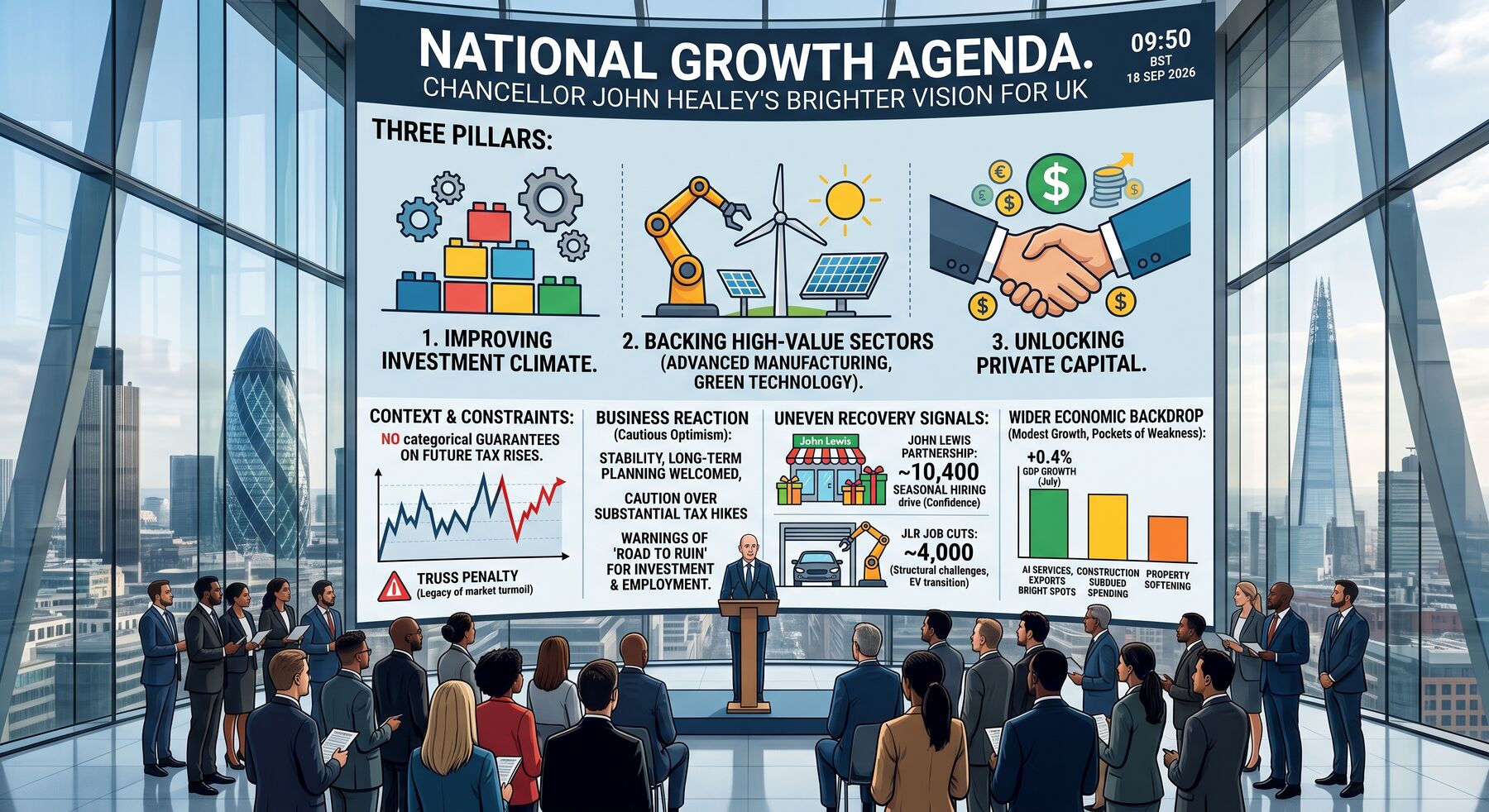
The most significant UK business and finance story today is Chancellor John Healey’s unveiling of a new national “growth agenda”, setting out the government’s economic strategy ahead of a crucial budget and in the shadow of warnings over potential tax rises and the lingering “Truss penalty”. This marks the clearest attempt yet by the new administration to reset the narrative on the UK economy, reassure markets, and signal its priorities to business and investors.
Healey’s speech, billed as a “growth” address, sets out a more optimistic vision for the UK economy while conceding that the room for major tax cuts or large-scale spending is constrained by what he has called the legacy costs of the previous government and the market turmoil triggered by the Truss premiership. Coverage today highlights two central themes: his insistence on an “optimistic story” for the UK and his refusal to rule out future tax rises, a combination that underscores the delicate balancing act between fiscal discipline and pro‑growth rhetoric. The speech is positioned not just as a policy statement but as a signal to global investors that the UK is committed to stability after years of volatility, including the mini‑budget crisis and persistent questions over the sustainability of the public finances.
Setting out a ‘brighter vision’ for UK growth
Reports on Healey’s remarks describe a comprehensive “growth agenda” that aims to place investment, jobs and productivity at the centre of economic policy. In media coverage today, the Chancellor is quoted as promising an “optimistic story” for the UK, a clear attempt to break from the era of low growth forecasts and repeated downgrades that have characterised the post‑Brexit and post‑pandemic period. The messaging emphasises stability and long‑term planning over short‑term giveaways, with the speech framed as an attempt to rebuild credibility with business after what he labels the “Truss penalty” – the ongoing cost to borrowing and confidence from the 2022 mini‑budget shock.
The growth agenda is expected to rest on three broad pillars: improving the UK’s investment climate, backing high‑value sectors such as advanced manufacturing and green technology, and working more closely with business to unlock private capital. While detailed policy measures will be reserved for the upcoming budget, today’s intervention is widely seen as setting the tone: reassuring markets that there will be no repeat of unfunded tax cuts, while signalling to firms that the government wants to be a predictable partner rather than a source of policy risk.
Tax, the ‘Truss penalty’ and fiscal constraints
One of the most closely watched elements of Healey’s comments has been his stance on taxation. Asked about the prospect of tax rises, the Chancellor refused to give categorical guarantees, stressing instead the need to deal with the “Truss penalty” and broader fiscal pressures. This term refers to the lingering impact of the 2022 mini‑budget, which led to a spike in gilt yields, higher borrowing costs and long‑lasting questions about the UK’s fiscal credibility. By explicitly referencing this penalty, Healey is making clear that much of the government’s room for manoeuvre is limited by past decisions, even as he attempts to turn the page.
Business groups and commentators are already warning that substantial tax hikes could be a “road to ruin” for firms if they fall on investment or employment at a time when the recovery is still fragile and inflation, while easing, continues to squeeze margins. At the same time, there is recognition that the Chancellor must work within tight constraints: debt servicing costs remain elevated, public services face intense pressure, and international investors are watching closely for signs of either renewed instability or credible consolidation. The result is a finely balanced message – no promises of sweeping tax cuts, no explicit commitment to major tax hikes, but a clear signal that fiscal realism will shape the growth agenda.
Business reaction: optimism tempered by caution
Early reaction from business circles reflects a mix of cautious optimism and concern. On the one hand, many firms welcome a clearer narrative from the Treasury after years of uncertainty, arguing that a consistent, long‑term strategy is more valuable than short‑term giveaways. The emphasis on stability and partnership with business aligns with calls from employers’ groups for predictable regulation and targeted support rather than sudden tax changes or abrupt shifts in industrial policy.
On the other hand, warnings from business leaders and regional chambers underline the risk that higher taxes or additional cost burdens could undermine the very growth the Chancellor is seeking to unlock. Commentators point to sectors already under strain – including construction, retail and hospitality, where margins remain thin and investment decisions highly sensitive to changes in business rates, payroll taxes and consumer confidence. Against this backdrop, Healey’s refusal to rule out tax rises is being read as an honest acknowledgement of fiscal reality, but also as a potential headwind if not carefully targeted.
Labour market and jobs: signals from major employers
Today’s broader news flow underscores the importance of jobs and labour market resilience within the growth debate. The John Lewis Partnership has announced a major seasonal hiring drive, creating around 10,400 temporary roles for Christmas and Black Friday, with the retailer highlighting the opportunity for young workers and those seeking flexible employment. This move is being framed as both a sign of confidence in consumer demand heading into the peak trading period and a reminder that growth must translate into tangible opportunities across the country.
At the same time, reports that Jaguar Land Rover plans to cut around 4,000 jobs as part of a £1.7bn cost‑cutting programme underline the structural challenges facing UK manufacturing. The contrast between new seasonal roles in retail and significant redundancies in the automotive sector captures the uneven nature of the recovery: service‑sector employment remains relatively robust, while capital‑intensive industries continue to grapple with global competition, the transition to electric vehicles, and the need for large‑scale investment. Healey’s growth agenda will be judged in part on whether it can help bridge these divides.
Wider economic backdrop: modest growth, pockets of weakness
The Chancellor’s speech comes against a backdrop of modest but better‑than‑expected economic data. Recent figures showed the UK economy growing by around 0.4% in July, with some analysts highlighting AI‑related business services and manufactured exports as bright spots. Intelligence gathered by the Bank of England’s regional agents indicates that output growth has improved in parts of business services and manufacturing, and that investment intentions have picked up slightly as firms adapt to ongoing uncertainty.
However, the same reports point to “significant pockets of weakness”, including subdued consumer spending, a continuing fall in construction activity and further softening in residential and commercial property markets. Pay settlements for 2026 have nudged only marginally higher, and credit supply continues to outstrip demand, reflecting cautious borrowing and investment behaviour across firm sizes. It is within this uneven landscape that Healey’s growth agenda must operate: trying to harness momentum in high‑growth sectors while addressing stubborn fragilities in others.
Political stakes ahead of the budget
Politically, today’s speech is a high‑stakes moment for a government seeking to define its economic identity. The Chancellor faces pressure from business groups and some commentators to avoid what they describe as a “road to ruin” via excessive tax hikes, while others insist that restoring credibility requires tough choices and a clear path to sustainable public finances. Healey’s decision to stress optimism while foregrounding the constraints of the “Truss penalty” reflects a calculation that voters and investors alike want candour about the trade‑offs.
With the budget looming, the growth agenda unveiled today is likely to be scrutinised for detail on investment incentives, infrastructure, skills and support for innovation, particularly in AI, clean energy and advanced manufacturing. For now, the message to markets and business is that the UK will prioritise stability, partnership and long‑term growth over abrupt policy lurches. The real test will come when those principles are translated into tax, spending and regulatory decisions that affect boardroom plans and household finances alike.
A FORWARD-THINKING AGENCY WITH A WORLD OF IDEAS *
A FORWARD-THINKING AGENCY WITH A WORLD OF IDEAS *