Scan to contact us

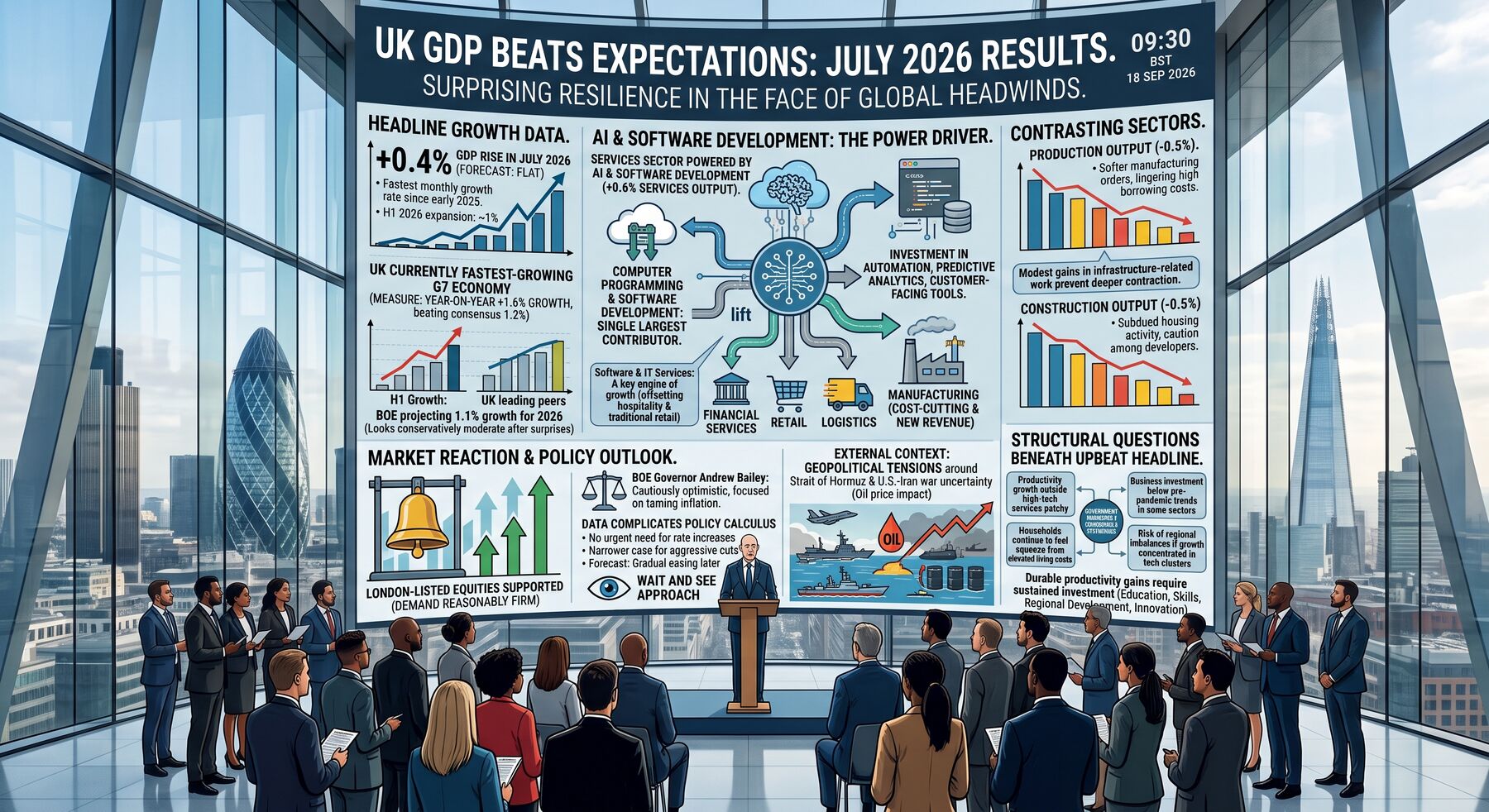
Britain’s economy beat expectations in July, delivering another month of solid growth that underscores the UK’s surprising resilience in the face of global headwinds and intensifying geopolitical tensions.
Latest official figures show gross domestic product (GDP) rose by around 0.4% in July, outpacing forecasts that had pointed to flat growth and extending the momentum built up over the first half of 2026. The expansion was driven overwhelmingly by the services sector, with a pronounced boost from artificial intelligence and software development, even as production and construction slipped.
Growth surprise strengthens UK’s 2026 outperformance
July’s stronger-than-expected reading marks one of the fastest monthly growth rates since early 2025 and builds on a 0.4% quarterly increase in the three months to July, matching the pace recorded in the previous three-month period. Year-on-year, output was up roughly 1.6%, beating economists’ consensus of around 1.2% and confirming that the UK is currently the fastest-growing economy in the G7 on this measure.
In the first half of 2026, GDP expanded by about 1%, putting Britain ahead of its peers in the group of major advanced economies despite the drag from higher energy prices linked to conflict in the Strait of Hormuz and wider uncertainty around the U.S.–Iran war. The Bank of England is projecting growth of about 1.1% for 2026 as a whole, a forecast that now looks modestly conservative given the run of upside surprises.
Liz McKeown, director of economic statistics at the Office for National Statistics (ONS), said ongoing strength in services was “only partially offset” by declines in production and construction, adding that AI appears to be lifting software development and related activities. Analysts caution that some of the apparent outperformance may reflect seasonal effects that statistical models have yet to fully adjust for, but agree that the broad picture is one of a more robust economy than many had anticipated at the start of the year.
AI and software power the services-led expansion
The ONS attributed much of July’s growth to a 0.6% rise in services output, with computer programming and software development making the largest single contribution. Artificial intelligence technologies and AI-related services have helped to boost activity over the past three months, providing a new source of demand across consulting, data analytics, cloud infrastructure and digital platforms.
This AI-driven upswing is being felt not just in tech firms but across a wide range of sectors, from financial services and retail to logistics and manufacturing, as companies invest in automation, predictive analytics and customer-facing tools to cut costs and capture new revenue streams. The ONS noted that software and IT services have become a key engine of growth within the broader services sector, offsetting weaker performance in more traditional areas such as hospitality and bricks-and-mortar retail.
By contrast, production and construction declined, each falling by around 0.5% in July. The dip in industrial output reflects softer manufacturing orders and the lingering impact of high borrowing costs, while construction continues to be weighed down by subdued housing activity and caution among commercial developers. Even so, modest gains in parts of manufacturing and infrastructure-related work helped prevent a deeper contraction.
Markets, rates and policy: what the data mean
Financial markets greeted the stronger GDP figures as evidence that the UK can withstand external shocks better than feared, with London-listed equities supported by the perception that domestic demand remains reasonably firm. Early commentary from City economists suggests the data complicate the Bank of England’s policy calculus, reinforcing the view that there is no urgent need to raise interest rates again but also narrowing the case for aggressive cuts in the near term.
Earlier this week, Bank of England governor Andrew Bailey signalled that policymakers are cautiously optimistic about the growth outlook but remain focused on taming inflation, which has been pushed higher at times by surging oil prices linked to tensions around the Strait of Hormuz. Some forecasters expect the Bank to hold its key rate steady at the next meeting before starting a gradual easing cycle later in the year, arguing that today’s data increase the likelihood of a “wait and see” approach rather than an immediate move.
At the same time, the AI-powered expansion raises strategic questions for ministers and regulators around digital infrastructure, skills and competition policy. The strength in software and programming underscores the importance of the UK’s push to become a global hub for AI and advanced data science, but also highlights the risk of regional imbalances if growth is concentrated in London and a handful of tech clusters.
Structural questions beneath the upbeat headline
While the headline numbers will be welcomed in Whitehall, economists warn that the UK’s recent outperformance does not eliminate deeper structural challenges. Productivity growth outside high-tech services remains patchy, business investment is still below pre-pandemic trends in some sectors, and households continue to feel the squeeze from elevated living costs.
The reliance on services – and on AI-related activities in particular – raises the risk that growth could prove vulnerable to regulatory changes, technology cycles or a slowdown in corporate investment if global financial conditions tighten further. With production and construction weakening, the economy’s foundations would look more secure if there were clearer signs of a broad-based recovery in manufacturing, housebuilding and infrastructure.
The government has sought to frame the latest figures as evidence that its industrial and digital strategies are working, pointing to a £1 billion programme to deliver new battery-electric trains for northern England and other targeted investments in clean technology and transport. But analysts stress that translating short-term AI-led gains into durable, economy-wide productivity improvements will require sustained investment in education, skills, regional development and innovation over many years.
For now, however, the message from the July data is that the UK is outperforming expectations at a time when global uncertainty is high. With AI reshaping the services sector and consumers proving more resilient than many feared, Britain enters the autumn with a growth profile that looks stronger than its recent reputation for stagnation would suggest.
A FORWARD-THINKING AGENCY WITH A WORLD OF IDEAS *
A FORWARD-THINKING AGENCY WITH A WORLD OF IDEAS *