Scan to contact us

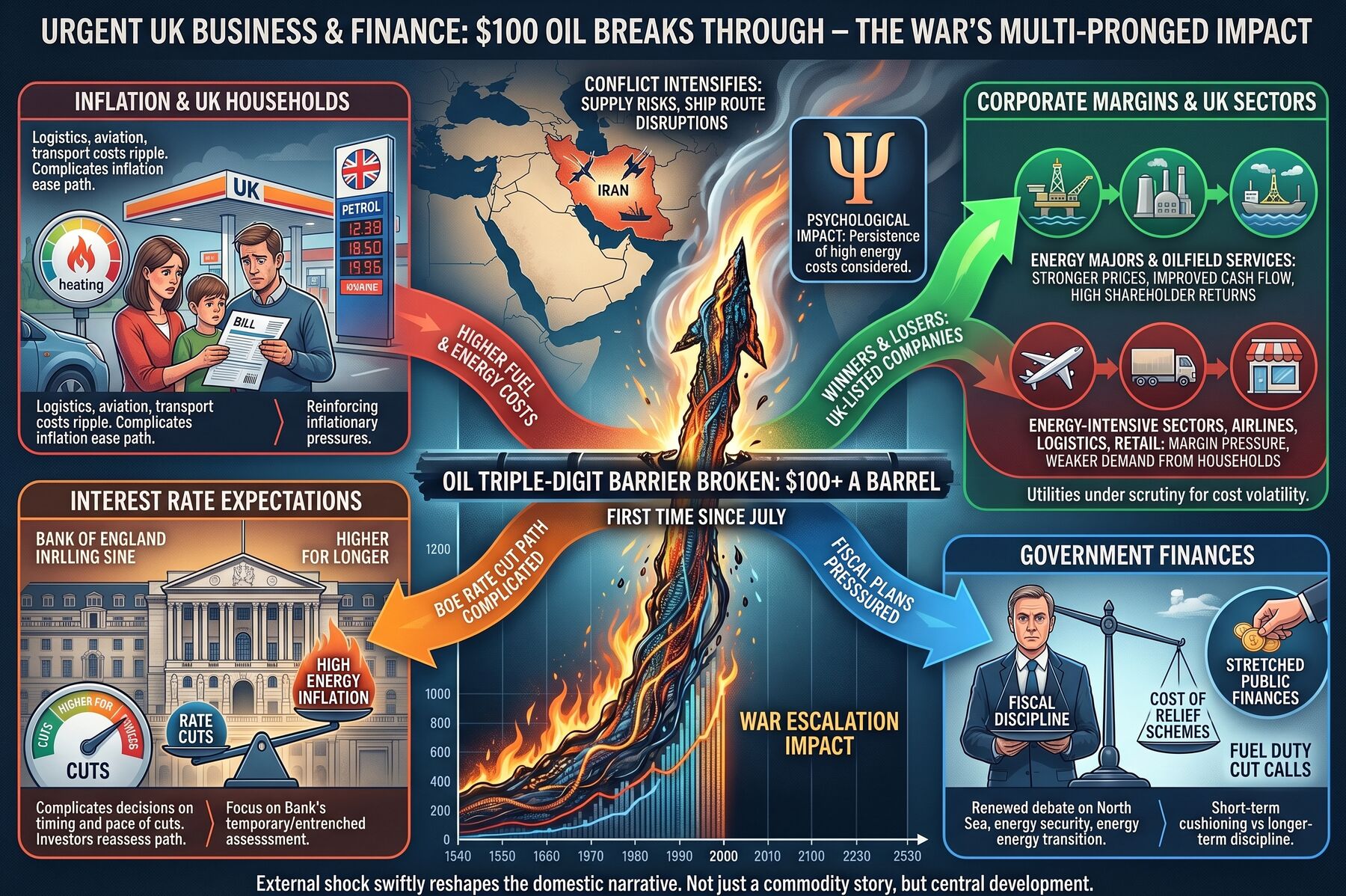
Oil prices breaking above $100 a barrel for the first time since July, as the Iran war escalates, is the most significant UK business and finance story today because it hits inflation, interest rate expectations, government finances and corporate margins all at once.
The renewed surge in crude prices raises the prospect of higher fuel and energy costs for households and businesses, complicating the Bank of England’s path on interest rates and putting fresh pressure on the next government’s fiscal plans.
Oil breaks $100 as Middle East conflict intensifies
Global oil markets moved sharply higher today, with benchmark prices climbing above $100 a barrel for the first time since July as the war involving Iran escalated, according to UK news coverage. Traders are pricing in a greater risk of supply disruption in a region that still accounts for a large share of global crude exports, particularly if the conflict affects key shipping routes or production sites.
While precise intraday price moves vary across benchmarks, the psychological impact of triple-digit oil is clear: markets are now confronting the possibility that higher energy costs could prove more persistent than previously assumed. The move comes against a backdrop of already tight supply, following previous output restraint by major producers and slower-than-expected investment in new capacity.
Immediate implications for UK inflation and interest rates
Oil at or above $100 a barrel is likely to feed quickly into UK pump prices, transport costs and some industrial input costs, reinforcing inflationary pressures that policymakers had hoped were easing. Higher fuel prices tend to ripple through supply chains, raising the cost of moving goods and operating fleets, particularly in logistics, aviation and road transport.
For the Bank of England, the latest shock complicates decisions on the timing and pace of any future interest rate cuts. A renewed burst of energy-driven inflation could force policymakers to keep borrowing costs higher for longer than financial markets had anticipated, potentially weighing on consumer spending, business investment and the housing market.
Investors will focus closely on how the Bank frames this shock in upcoming speeches and reports, especially its assessment of how temporary or entrenched the oil spike might be. If the conflict escalates further or leads to identifiable supply disruptions, market pricing for UK rate cuts could shift significantly.
Pressure on government finances and political priorities
The UK government also faces difficult choices. Higher energy prices tend to increase the cost of existing support schemes and can prompt renewed calls for fuel duty cuts or targeted relief for vulnerable households and small businesses. Any such measures would add pressure to already stretched public finances.
Ministers must balance the short-term political imperative of cushioning households from rising costs with longer-term commitments to fiscal discipline and investment in the energy transition. A prolonged period of high oil prices could revive debates over North Sea production, energy security, and the pace of the shift toward renewables and electrification.
Impact on UK-listed companies and sectors
In equity markets, higher oil prices create winners and losers. UK-listed energy majors and oilfield services firms typically benefit from stronger prices, with improved cash flow and potential for higher shareholder returns. Conversely, energy-intensive sectors and companies heavily exposed to fuel costs – such as airlines, logistics groups, and parts of manufacturing and retail – face margin pressure.
Retailers and consumer-facing businesses may see demand soften if households respond to higher fuel and energy bills by tightening discretionary spending. At the same time, utilities and power generators will be under scrutiny for how they manage fuel cost volatility and pass-through to customers.
Broader economic and market sentiment
Beyond direct cost effects, the return of $100 oil has a broader confidence impact. It underscores the fragility of the global economic outlook, raises geopolitical risk premia across assets, and may encourage investors to rotate towards perceived safe havens or inflation hedges.
For the UK, which remains closely tied to global energy markets despite domestic production, the escalation of the Iran war and resultant price shock is a clear reminder that external shocks can swiftly reshape the domestic economic narrative. Today’s move in crude prices is therefore not just a commodity story, but a central development for UK business, finance and economic policy.
A FORWARD-THINKING AGENCY WITH A WORLD OF IDEAS *
A FORWARD-THINKING AGENCY WITH A WORLD OF IDEAS *