Scan to contact us

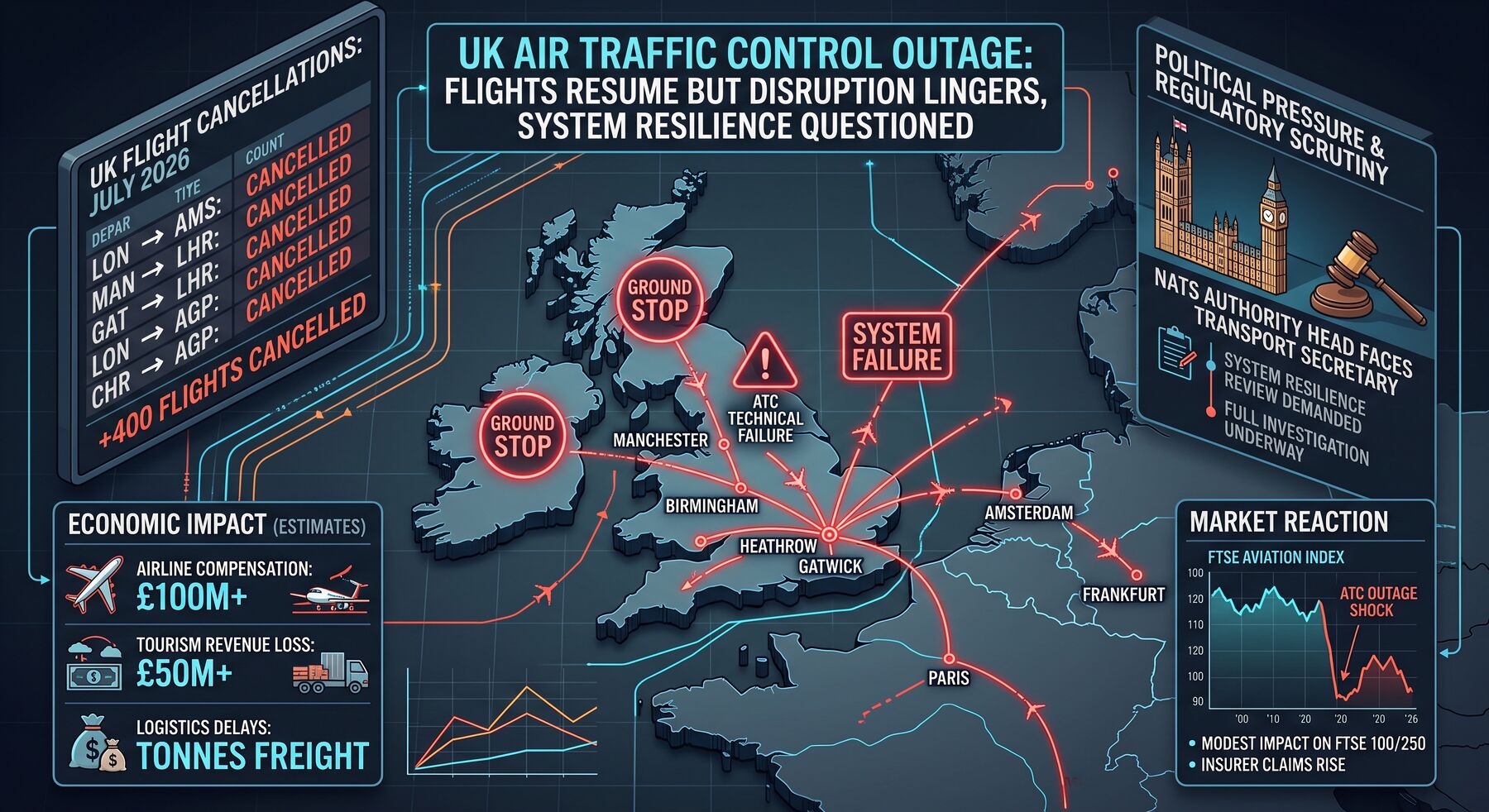
The UK’s most significant business story today is the continuing fallout from the country’s major air traffic control outage, with UK flights resuming but airports warning of ongoing disruption
Services are restarting across the UK network after more than 400 flights were cancelled when the air traffic control system was hit by a technical failure, but airports and carriers say the disruption will continue into the evening and potentially into the coming days as they work through backlogs and crew dislocations. The head of the air traffic control authority is due to face the UK transport secretary today, underscoring the political and regulatory pressure over the resilience of critical aviation infrastructure.
Flights resume but disruption lingers
Airports across the UK reported that flights had resumed this morning after engineers resolved the air traffic control issue that forced widespread cancellations and delays. Market bulletins and business wires noted that operations were stabilising but far from normal, with airports warning that passengers should expect ongoing disruption into the evening as schedules are rebuilt and aircraft and crews are repositioned.
The outage led to more than 400 flights being cancelled, stranding tens of thousands of passengers and creating knock-on effects across European hubs. Airlines are now working to rebook affected travellers, meet legal obligations for care and compensation, and adjust capacity for the remainder of the week.
Economic and business impact
Today’s disruption is not only a transport story but a significant business and economic event for the UK. Aviation and tourism are key contributors to UK GDP, and large-scale flight cancellations impose direct costs on airlines, airports, handling companies and insurers, as well as indirect losses for hotels, retailers and business travellers facing missed meetings and delayed shipments. While the overall macroeconomic impact is likely to be modest against a backdrop of steady but moderate growth, episodes like this raise questions about the robustness of the infrastructure underpinning an open, services-led economy.
The timing is sensitive: the UK economy has been posting “fairly solid” quarterly growth, with GDP up 0.4% in the three months to June, a slight moderation from 0.6% in the first quarter. Against that background, any repeated or prolonged disruption to transport networks could weigh on confidence in sectors such as aviation, tourism and logistics that are still adjusting to post-pandemic travel patterns.
Political pressure and regulatory scrutiny
The head of the UK’s air traffic control authority is scheduled to appear before the transport secretary today, a sign of the political urgency around understanding how a single technical failure could trigger nationwide cancellations. Ministers are expected to seek assurances about system resilience, contingency planning, and the timeline for a full investigation.
For the business community, the focus will be on whether regulators demand new investment in technology and redundancy, and how any upgrades are funded. Air traffic control infrastructure is typically financed through charges on airlines, which in turn feed into ticket prices, so any substantial capex programme could have implications for carriers’ cost bases and consumer fares.
Airlines, airports and insurers count the cost
Major UK airlines and airports now face the immediate task of quantifying the financial impact of the outage. Under UK and EU-derived passenger rights rules, carriers can be liable for accommodation, meals and, in some cases, compensation where delays and cancellations are deemed their responsibility, though technical failures in third-party infrastructure can sit in a complex legal grey area.
Insurers specialising in aviation and travel disruption are also likely to see claims related to missed connections, abandoned trips and business interruption. For listed airlines and airport operators, investors will be watching for any guidance in upcoming trading updates about the one-off hit from the incident and any changes to risk assessments around operational resilience.
Business travel and logistics ripple effects
Beyond passenger holidays, the outage has implications for corporate travel and high-value logistics that rely on predictable flight schedules. Delayed executives, missed pitches and rescheduled board meetings can have intangible but real costs for UK businesses seeking to close deals or manage overseas operations.
Air freight and express parcel services may also face backlogs, especially on routes where bellyhold cargo in passenger aircraft forms a material part of capacity. Any disruption to just-in-time supply chains, even if short-lived, underscores the dependence of modern commerce on reliable aviation infrastructure.
Investor sentiment and market context
The disruption comes against a backdrop of relatively calm UK equity markets, with the FTSE 100, FTSE 250 and broader FTSE indices trading close to flat in early indications today. Market commentary so far suggests investors view the outage as a one-off operational shock rather than a structural threat to the sector, though the incident may feed into longer-term debates about infrastructure risk and contingency planning in transport.
For policymakers, the episode is another reminder that maintaining confidence in the UK as a global hub for finance, business services and tourism depends on resilient physical and digital infrastructure. As flights resume and the immediate crisis eases, the key question for the business community will be whether lessons from this outage translate into concrete investment and governance reforms, or fade once timetables return to normal.
A FORWARD-THINKING AGENCY WITH A WORLD OF IDEAS *
A FORWARD-THINKING AGENCY WITH A WORLD OF IDEAS *